
Visiting Manzanar National Historic Site
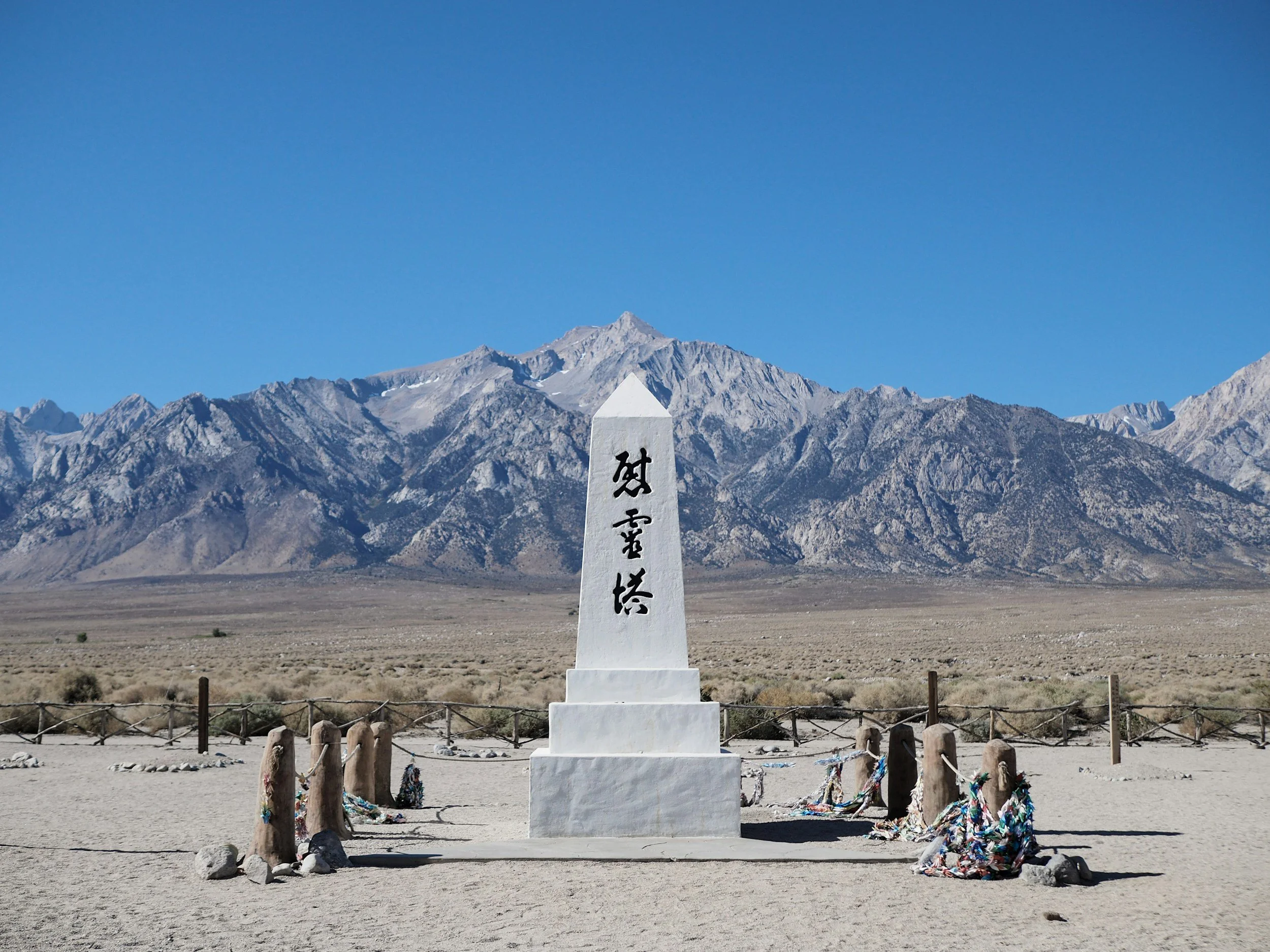
Soul Consoling Tower at Manzanar
Manzanar National Historic Site sits on Highway 395 in the Owens Valley, between Lone Pine and Independence and about 40 minutes south of Big Pine. During World War II it was one of ten camps where the United States government incarcerated Japanese Americans, most of them U.S. citizens, behind barbed wire and guard towers. Today the National Park Service preserves it as a place to learn, remember, and reflect.
A visit is free, and most people come away describing it as sobering and unforgettable. This guide covers the practical side: how long to plan, what to see, when the visitor center is actually open, and how to reach it from a base in Big Pine, so you can give the place the time and attention it deserves.
What is Manzanar?
In February 1942, two months after the attack on Pearl Harbor, President Roosevelt signed Executive Order 9066, which led to the forced removal of more than 110,000 Japanese Americans from the West Coast. Manzanar was the first of ten War Relocation Authority camps built to confine them. More than 11,000 people were incarcerated here between 1942 and 1945, held in tar-paper barracks in the high desert, watched over by armed guards. About two-thirds were American citizens by birth, and none had been charged with any crime.
The camp closed in 1945, and the buildings were mostly torn down. What remains- the foundations, the gardens, a handful of reconstructed structures, and the memories preserved in the visitor center- is now protected so the history is not forgotten. Following the National Park Service and the Japanese American community, this guide uses “incarceration” rather than the older euphemism “internment,” which does not accurately describe the imprisonment of U.S. citizens without charge or trial.
How Long Do You Need?
Most visitors spend about two hours, and that is a good target. Here is how it breaks down, so you can match the visit to your day.
One hour: The visitor center exhibits and the 22-minute film. Enough for the essentials if you are passing through on Highway 395.
Two hours: Add Block 14, the reconstructed barracks, mess hall, and latrine, where the crowding and lack of privacy of daily life come through.
Three to four hours: Drive the full 3.2-mile self-guided auto tour with stops, and walk out to the gardens and the cemetery. This is the visit the place deserves if you have the time.
Even on days the visitor center is closed, the grounds and Block 14 stay open, so the site is worth the stop any day of the week.
What to See
The visitor center and film. Housed in the camp’s restored high school auditorium, the visitor center holds the main exhibits, a scale model of the camp built by former incarcerees, and a wall listing the names of the more than 10,000 people held here. The award-winning 22-minute film, “Remembering Manzanar,” runs every half hour and is the right place to begin.
Block 14. A short walk from the visitor center, Block 14 has two reconstructed barracks, a mess hall, and a women’s latrine. The barracks interiors, with their cots, thin mattresses, and a child’s corner, are where camp life becomes real. The latrine, with its rows of toilets and no partitions, is the detail visitors mention most often.
The auto tour. A 3.2-mile self-guided road loops through the grounds; pick up a map at the visitor center. It passes the original stone sentry posts at the entrance, the barracks foundations, the rebuilt gardens, and the cemetery. Driving it is the best way to grasp the sheer scale of the place, and on a hot day you can see much of the site from the car.
The gardens. Incarcerees built more than a hundred gardens to bring beauty and shade to a harsh place. Eleven have been uncovered, including Merritt Park, the most elaborate. Quiet and unexpected, they are among the most moving things here, small acts of resilience in the desert.
The cemetery and Soul Consoling Tower. At the back of the site, a white obelisk stands against the wall of the Sierra Nevada. Incarcerees built it in 1943, and the three characters on its face mean “soul consoling tower.” It is the image nearly everyone remembers, and the emotional heart of a visit. Families still leave paper cranes and other offerings at its base; leave them as you find them.
Hours and When to Go
The grounds and the auto tour road are open every day, sunrise to sunset. The reconstructed barracks at Block 14 are open daily, roughly 9 a.m. to 4:15 p.m. The visitor center, with the film, exhibits, bookstore, and indoor restrooms, is currently open Friday through Monday and closed Tuesday, Wednesday, and Thursday. That schedule has changed more than once, so check the National Park Service site the week you go. If a midweek visit is all your trip allows, come anyway. The grounds and Block 14 are still open, and still powerful.
As for the season, spring and fall are the most comfortable, with mild days and often snow still on the peaks behind the site. Summer is hot, frequently over 100 degrees with almost no shade, so come early and carry water. Winter is quiet and cold, and the Sierra is at its most dramatic. Wind and blowing dust are common in any season, a small reminder of what daily life here was like.
Getting There and Getting Around
Manzanar is on the west side of Highway 395, about 6 miles south of Independence and 9 miles north of Lone Pine. From Big Pine, it is about 35 miles south, roughly 40 minutes. From Bishop, figure about an hour.
There is no food, gas, or store on site, and only a drinking fountain at the visitor center. Fuel up and pack water and snacks before you come, in Big Pine, Independence, or Lone Pine. Cell service is spotty along this stretch of 395, so download your directions and the park’s audio tour ahead of time. The auto tour road is flat, well-graded dirt that any car, and most RVs, can handle.
Visiting Respectfully
Manzanar is a memorial, and for many families it is sacred ground. The cemetery is an active place of remembrance, and each April descendants and supporters gather here for the annual Manzanar Pilgrimage. A few simple things help: keep a quiet, reflective demeanor, stay on the established paths and roads, and leave artifacts, offerings, and the landscape exactly as you find them.
Visiting with Kids, Accessibility, and Pets
Kids. The history is heavy but approachable. Older children often connect with it through the barracks and the Junior Ranger program, with activity booklets available at the visitor center. Jeanne Wakatsuki Houston’s memoir “Farewell to Manzanar” is good preparation for a family visit.
Accessibility. The visitor center is wheelchair accessible, with a loaner wheelchair, a captioned film, and accessible parking. The auto tour is drivable, and paved paths and ramps reach the accessible barracks. A few approaches, including the mess hall and the cemetery, are sandy. There is an accessible restroom at the cemetery parking area.
Pets. Leashed pets are welcome on the grounds and in the Block 14 exhibits, but not in the visitor center or the fenced cemetery. There is no shade and summer heat is dangerous, so never leave an animal in a parked car.
Manzanar on a Highway 395 Road Trip
Manzanar is usually a stop rather than a destination, and it fits naturally into an Eastern Sierra road trip. Many people pair it with the Alabama Hills and the Museum of Western Film History in Lone Pine, the Eastern California Museum in Independence, or a day in Death Valley to the east. Big Pine is approximately 40 minutes north of Manzanar and can serve as a convenient base for visitors exploring several places along Highway 395. Palisades Lodge offers furnished apartments with kitchens for short- and extended-stay accommodations in the Eastern Sierra. Our Highway 395 road trip guide lays out the full route.
Where to Stay
Big Pine sits about 40 minutes north of Manzanar, near the center of the Eastern Sierra, which makes it a practical base for a trip that also takes in the Ancient Bristlecones, Big Pine Lakes, and the drive north toward Mammoth and Mono Lake. Palisades Lodge of Big Pine has fully furnished apartments with kitchens and quiet nights, with weekly and monthly rates for longer stays in the valley.
Frequently Asked Questions
-
Nothing. Admission is free, and no pass is required.
-
About two hours is typical. Give it an hour for the visitor center and film if you are short on time, or three to four hours to include the full auto tour, the gardens, and the cemetery.
-
No. The visitor center is currently open Friday through Monday and closed Tuesday through Thursday. The grounds, the auto tour, and the Block 14 barracks are open every day, so the site is worth visiting midweek even when the visitor center is closed. Check the National Park Service site for current hours before you go.
-
Yes. Manzanar offers an important and often deeply affecting account of Japanese American incarceration during World War II.
-
About 35 miles south on Highway 395, roughly 40 minutes.
-
Yes, with a little preparation. Older kids engage through the barracks and the Junior Ranger program, and the memoir “Farewell to Manzanar” helps set the stage beforehand.
-
Leashed pets are welcome on the grounds and in Block 14, though not in the visitor center or the cemetery. The visitor center and much of the site are wheelchair accessible, with a loaner wheelchair and accessible parking.
-
Water, sun protection, and a full tank of gas. There is no food, gas, or store on site, and cell service is limited, so download maps before you arrive.
AT A GLANCE
Location: Highway 395, between Lone Pine and Independence, about 40 minutes south of Big Pine
Admission: Free, no pass required
Hours: Grounds and auto tour daily, sunrise to sunset; Block 14 barracks daily; visitor center Friday through Monday (see below)
Time needed: Two to three hours gives enough time to explore the visitor center, Block 14, portions of the auto tour, the gardens, and the cemetery without rushing.
Best time: Spring or fall for mild weather; early morning in summer
On site: No food, gas, or store, so fuel up and bring water first
Don’t miss: The reconstructed barracks and the cemetery monument standing beneath the Sierra Nevada
